Water Extraction in Eagan, Minnesota

Water Extraction services in Eagan, Minnesota

Water Extraction removes standing and absorbed water from your home or building after a leak, overflow, appliance failure, storm intrusion, or flooding event. Our team pumps out water, removes moisture from affected materials, and helps begin structural drying before damage spreads. Fast action can limit damage to floors, walls, contents, and indoor air quality.

Our team provides service across Eagan, including neighborhoods and local areas such as Cedar Grove, Lexington-Diffley, Thomas Lake, and Yankee Doodle.

We provide water removal for homes, condominiums, apartments, offices, retail spaces, schools, healthcare properties, and industrial buildings throughout Eagan and the Minneapolis-St. Paul Metro Area. Our quick 1-Hr Local Response helps us begin evaluating the source, the visible water, and the areas that may hold hidden moisture.

A wet floor is only part of the problem. Water can move beneath carpet, into pad and subfloors, behind baseboards, and into wall cavities. Our IICRC-certified technicians use moisture checks and appropriate extraction equipment so you can make decisions based on the actual condition of your property.

Water Removal and Pump-Out Service for Eagan Properties

The first step is identifying and, when possible, stopping the water source. Common causes include burst or frozen plumbing, a failed water heater, an overflowing appliance, a sump pump failure, roof or storm intrusion, and sewer or drain backups. The source affects the safety steps, the equipment needed, and whether some materials should be removed rather than dried in place.

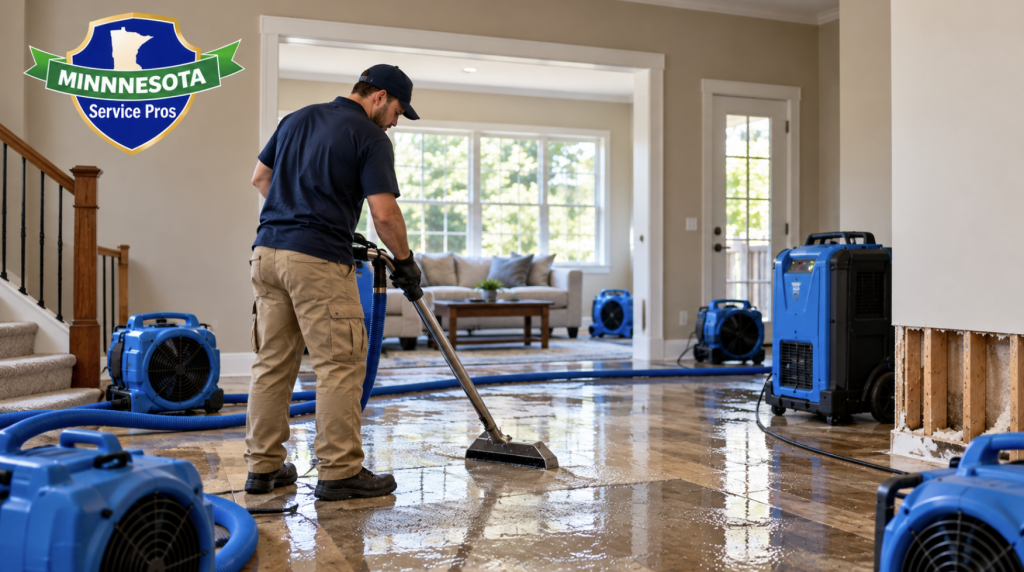
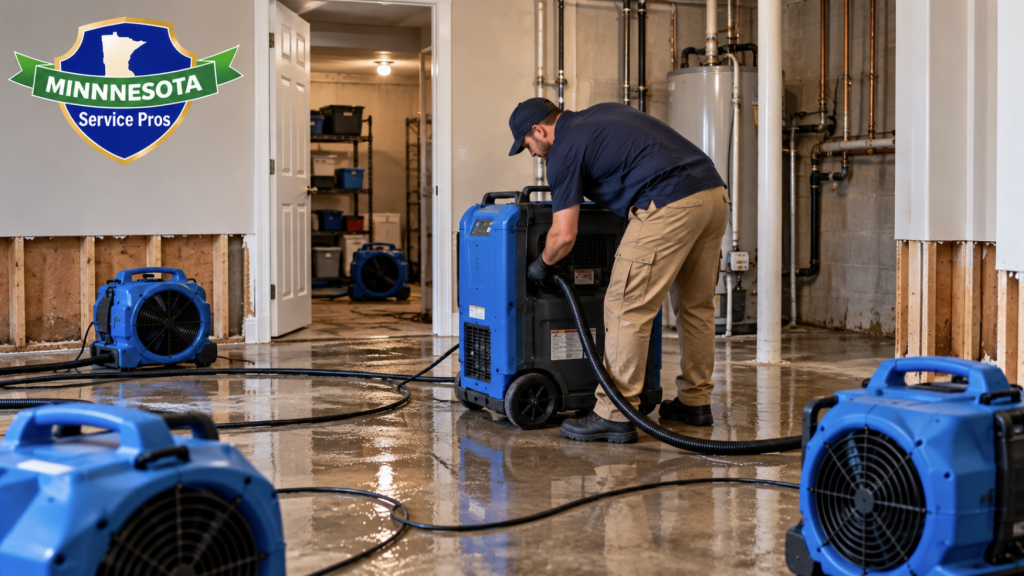
Standing water is usually removed with portable extractors or submersible pumps, depending on the depth and location. Shallow water on hard-surface flooring may require a different approach from several inches in a basement or mechanical room. Water removal is followed by moisture evaluation because materials can stay wet after the surface looks dry.

Wet carpet and carpet pad often hold more water than they appear to. Our technicians check the carpet, pad, tack strips, and subfloor before deciding what can be dried and what may need removal. Hard-surface flooring also requires attention at seams, edges, and beneath floating materials.

Moisture meters help locate damp areas in drywall, trim, framing, and flooring. If water has entered a wall cavity or subfloor, air movers and dehumidifiers can support structural drying after excess water has been removed. Moisture monitoring helps show whether drying is progressing rather than relying only on how a surface feels.

Water Extraction is one part of the larger water damage restoration process. If the water is contaminated, if mold is present, or if building materials are damaged beyond drying, our team explains the next steps and the safety concerns before work continues.

Water Extraction company serving Eagan, Minnesota

Who We Help in Eagan

Homeowners may call us after a plumbing leak, water heater failure, appliance overflow, basement seepage, or sump pump problem. We can help you understand what is wet, what should be moved, and which materials need immediate attention.

Property managers and residents in multifamily buildings may need coordinated extraction when water travels between units, corridors, utility rooms, or shared walls. Our technicians consider access, occupants, electrical safety, and the possibility of moisture affecting spaces that were not visibly flooded.

Owners of offices, stores, schools, healthcare spaces, and industrial properties may need water removal that protects people while reducing disruption. Larger buildings often require a plan for affected zones, equipment placement, access routes, contents, and continued operations.

What to Expect From Our Water Removal Process

Our approach starts with the condition of your property rather than a preset equipment list. We look at the water source, the category of affected water, the materials involved, the depth of standing water, and the possibility of hidden moisture.

You receive a clear explanation of what we find and why a particular extraction or drying step is recommended. We separate water removal from structural drying so you know what has been completed and what still needs monitoring.

Our technicians are IICRC certified, and we are BBB certified in Minnesota. These credentials support a careful, documented approach, while the property assessment remains the basis for each decision.

Small losses and larger projects can require different planning, but both benefit from prompt control of the water source, thorough extraction, and moisture checks. Our quick 1-Hr Local Response is available for starting that evaluation.

  1. We discuss what happened, when it happened, and whether the water source has been stopped. If active water or electrical hazards remain, safety comes before entering or moving contents.
  2. Our crew inspects accessible areas and documents visible damage. We check flooring, walls, ceilings, contents, utility areas, and nearby spaces that may have received migrating water.
  3. Standing water is removed with the appropriate pump or extractor. We protect unaffected areas when possible and handle wet contents according to their material, condition, and location.
  4. Moisture testing identifies damp materials below the surface. Readings can guide decisions about carpet, pad, drywall, cabinets, subfloors, and other building components.
  5. Air movers and dehumidifiers may be placed to support drying. Equipment location depends on the affected materials, air movement, temperature, humidity, and safe access to the area.
  6. We monitor the drying process and explain the results. If materials cannot be safely dried or if additional restoration is needed, you receive information about the condition and the next practical step.

What Eagan Property Owners Should Know

Eagan properties include single-family homes, townhomes, condominiums, apartments, offices, retail buildings, and industrial spaces. Many homes have finished or unfinished basements where a plumbing leak, foundation seepage, or sump pump failure can affect flooring, stored belongings, framing, and mechanical areas.

Cold Minnesota winters create a risk of frozen and burst pipes, especially in exterior walls, garages, utility areas, and spaces with limited heat. After a freeze, water may continue spreading after the pipe has failed, so checking nearby walls, ceilings, and flooring is important.

Heavy rain and rapid snowmelt can challenge drainage systems and basement walls. Grading, downspouts, sump pumps, and foundation conditions all influence how water enters a property. Flood cleanup may require pumping, removal of damaged contents, and drying beyond the visibly wet area.

The Minneapolis-St. Paul Metro Area also experiences strong seasonal temperature changes. Materials expand, contract, and absorb moisture differently as conditions change. Drying equipment and monitoring help address moisture that may remain beneath flooring or inside assemblies.

Water Extraction help for property owners in Eagan, Minnesota

Seasonal Conditions That Can Lead to Standing Water

Winter pipe breaks can release water into finished basements, kitchens, bathrooms, garages, and wall cavities. Do not touch electrical equipment or enter standing water near outlets, furnaces, or appliances until the area is considered safe.

Spring snowmelt and heavy rain can overload drainage paths or expose weaknesses around foundations. Water that enters through a lower level may affect carpet, pad, drywall, stored items, and the subfloor even when the visible pool is small.

Summer storms can bring wind-driven rain, roof leaks, and localized flooding. Water coming from outside may carry soil or other contaminants, which can change the required cleanup method and the materials that can be salvaged safely.

A Common Flood Water Removal Scenario in Eagan

A homeowner in Eagan might discover water around a failed water heater and assume that mopping the floor has solved the problem. Our team may find moisture beneath the flooring, inside nearby drywall, or in the subfloor. We would remove remaining water, check surrounding materials, and explain whether drying or removal is appropriate.

In a condominium or apartment building, a supply-line leak may affect one unit and the space below it. Extraction may need to address flooring, ceilings, shared walls, and contents while access is coordinated with occupants or property management. The visible room is not always the full affected area.

What Our Customers Say

“Our upstairs bathroom line let go around two in the morning and water was coming through the kitchen ceiling. I called expecting to leave a voicemail and someone actually picked up. The crew was at the house in under an hour with fans and a pump. They walked me through what they were doing instead of just working around me, and by the third day everything read dry.”

— Kate Williams

Commercial Water Removal for Larger Properties

Commercial properties along the Yankee Doodle Road corridor, in the Cedar Grove area, and within Eaganu2019s industrial and business areas can include offices, retail spaces, service businesses, warehouses, and other occupied facilities. Water removal planning may need to account for customer and employee access, inventory, equipment, loading areas, shared walls, business interruption, and drying equipment that can operate without blocking essential routes.

Commercial Water Extraction often requires a coordinated plan rather than a single room cleanup. We can divide a larger loss into work zones, identify safe access routes, protect unaffected areas, and prioritize spaces that support building operations. Offices, retail properties, schools, healthcare spaces, and multifamily buildings may need work scheduled around occupants and essential functions.

Larger losses can involve deeper standing water, multiple floors, shared plumbing, mechanical rooms, storage areas, or industrial equipment. Our team evaluates pump-out needs, extraction capacity, contents handling, moisture monitoring, and the placement of air movers and dehumidifiers. Documentation helps property owners and managers track affected areas and drying progress.

Business continuity and safety remain part of the restoration plan. We discuss access restrictions, noise, power needs, occupant movement, and areas that should remain closed during extraction or drying. For condos and multifamily properties, communication between residents, managers, and building representatives can help prevent missed moisture in adjacent units or common areas.

We can plan our service around projects of different sizes, from smaller affected areas to larger losses involving retail properties, offices, hospitals, schools, condos and multifamily buildings, and industrial properties.

Estimated Water Removal and Extraction Pricing

Every loss is different, so these general ranges are provided only to help with early planning. Your final cost can change based on the source of the problem, affected square footage, materials, contamination, access, equipment needs, drying time, demolition, cleaning, and repairs.

  • Small project: $1,000–$3,500+
  • Moderate project: $5,000–$10,500
  • Large project: $10,500+

These prices are estimates for general reference only, not a quote for your property. An onsite inspection is required before our team can provide a complete price estimate. The affected area, materials, moisture or contamination, equipment needs, and full scope of work all have to be evaluated first.

Working With Insurance After Property Damage

We can help you organize information about the loss, affected areas, extraction work, moisture findings, and drying progress for your insurance discussion. Coverage depends on your policy and the cause of the damage, so contact your insurer for claim instructions and keep records of the event, temporary measures, and restoration documents.

Popular insurance companies we work with include: State Farm, Allstate, Farmers Insurance, Travelers, Liberty Mutual, American Family Insurance, USAA, and Nationwide.

Our team can help document the damage and work performed, but coverage and claim decisions depend on your policy, the cause of loss, and your insurance carrier. You should contact your carrier directly with coverage questions.

Water Removal Services in Nearby Communities

Our service area also includes nearby communities such as Minneapolis, Bloomington, and Plymouth.

Water Extraction and Water Removal FAQs

How soon should water be removed from my property?

Begin safe water removal as soon as possible. Standing water can move into flooring, walls, contents, and lower building assemblies. If the area has electrical hazards, sewage, structural concerns, or an active leak, leave the area and wait for qualified help or utility guidance.

Can I remove the water with a household wet vacuum?

A small amount of clean water may be manageable with suitable equipment, but household tools may not reach water beneath flooring or inside materials. Do not use electrical equipment in or near standing water. A professional assessment is useful when water has spread, materials are saturated, or the source is contaminated.

Will wet carpet always need to be replaced?

Not always. The answer depends on the water source, how long the carpet and pad were wet, the amount of contamination, and the condition of the carpet, pad, and subfloor. We inspect these layers and explain whether cleaning and drying are reasonable or removal is safer.

Why is drying needed after the standing water is gone?

Materials can retain moisture after surface water has been removed. Subfloors, drywall, wall cavities, insulation, cabinets, and carpet pad may continue holding water. Air movement, dehumidification, and moisture monitoring help reduce the risk of prolonged dampness.

What should I do before the restoration team arrives?

If safe, stop the water source, move small items away from the affected area, and document the damage with photographs. Avoid walking through contaminated water, operating electrical equipment in wet areas, or disturbing materials that may contain hazardous substances.

Can water damage affect rooms that look dry?

Yes. Water can travel beneath flooring, along baseboards, through framing, and into rooms below or beside the original leak. Moisture checks help identify areas that need drying even when there is little visible water.

Scroll to Top