Water extraction removes standing and absorbed water from your home or business after a leak, overflow, appliance failure, storm intrusion, or other water event. We use pumps, portable extractors, and careful moisture checks to remove water before it spreads farther into flooring, walls, and contents.
Property owners throughout Minnetonka can call our team for help, including those in and around Glen Lake, Minnetonka Mills, and Groveland.
Our team serves property owners throughout Minnetonka and the Minneapolis-St. Paul Metro Area. Quick action can limit damage to carpet, pad, hardwood, subfloors, drywall, and cabinets. We offer a quick 1-hour local response, and our IICRC-certified technicians assess the affected areas so you can understand what needs to happen next.
A small amount of visible water can hide a larger problem below the surface. We focus first on safety, the water source, and the extent of moisture. Then we remove what we can, document conditions, and plan the structural drying needed to help your property recover.
Water Removal and Pump-Out Service for Minnetonka Properties
Water removal begins with identifying and stopping the source when possible. Common causes include a failed supply line, broken water heater, overflowing toilet, sump pump failure, appliance leak, roof intrusion, or water entering during a storm. If the source is still active, contact the appropriate plumber or utility professional while we address the resulting damage.
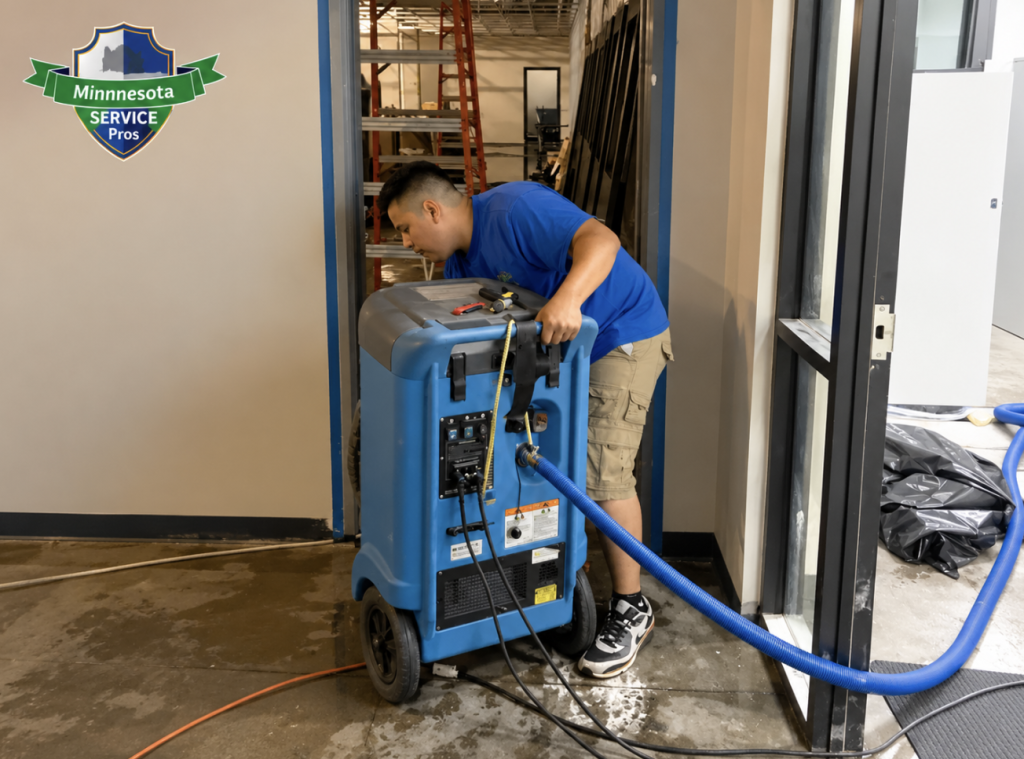
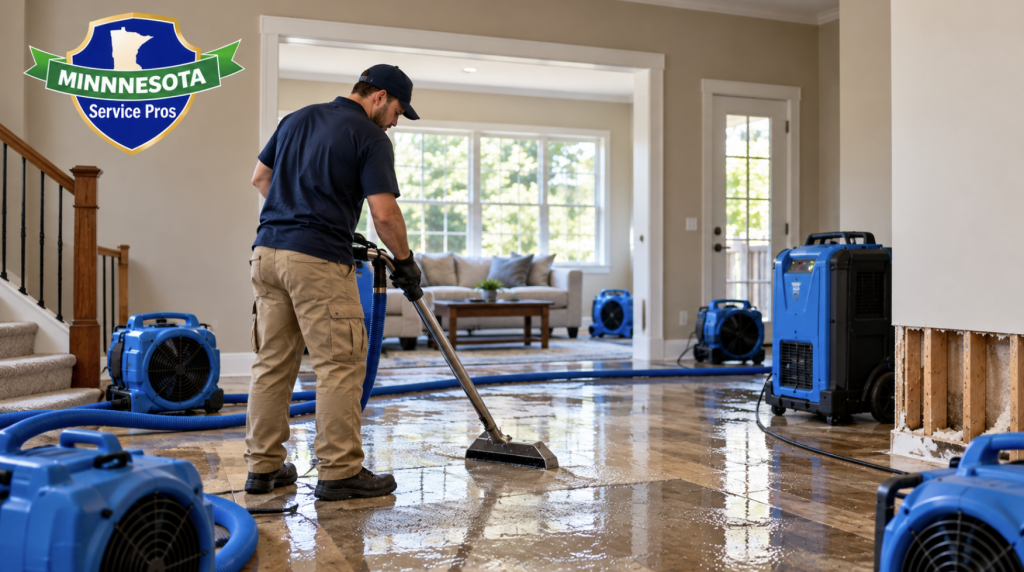
Standing water is removed with submersible pumps when depth or volume requires it. Portable extractors help pull absorbed water from wet carpet, carpet pad, upholstery, and other materials. On hard-surface flooring, we remove surface water and check seams, edges, transitions, and nearby materials where moisture can collect.
Visible water is only part of the assessment. Moisture meters help us evaluate drywall, baseboards, subfloors, cabinets, and wall cavities. These readings guide the placement of air movers and dehumidifiers. Removing water without drying the structure can leave moisture trapped where odors, deterioration, or microbial growth may develop.
Carpet and pad do not always respond the same way. Some materials may be cleaned and dried, while saturated pad or damaged materials may need removal. Hardwood, laminate, vinyl, and tile also require different handling. Our technicians look at the material, the type of water, the length of exposure, and the condition of the underlying surface before recommending the next step.
Water extraction is usually the first part of water damage restoration, not the entire project. After the pump-out or extraction, structural drying continues until moisture levels are reduced and monitored. If water has affected drywall, insulation, cabinetry, or other building components, additional restoration work may be needed.

Who We Help in Minnetonka
We help homeowners dealing with a burst pipe, washing machine leak, refrigerator line failure, water heater problem, or overflowing fixture. You may need service after returning from work to find water across a lower level, or after noticing soft flooring, stained walls, or damp odors.
Our work also supports landlords, condo owners, property managers, and multifamily residents. Water can move between units, along shared walls, through floor assemblies, or into common areas. Early documentation and moisture mapping can help identify which spaces need attention and reduce confusion during a larger cleanup.
Commercial and institutional properties may need extraction after plumbing failures, sprinkler issues, roof leaks, equipment problems, or storm water entry. Offices, retail spaces, schools, medical facilities, warehouses, and industrial buildings often require careful scheduling so occupants, staff, inventory, and operations can remain as safe and functional as possible.
What to Expect From Our Water Removal Process
We keep the assessment focused on your property and the decisions in front of you. You will learn where moisture was found, which materials are affected, what equipment is being used, and what conditions need to be checked during drying.
Our technicians are IICRC certified, giving our team a recognized framework for water damage assessment, extraction, drying, and restoration practices. We are also BBB Certified in Minnesota. These facts do not replace a property-specific inspection, so our recommendations are based on the actual water source, materials, and moisture readings.
The quick 1-hour local response is intended to help us reach you promptly when timing matters. Arrival time can still depend on conditions, access, weather, and the nature of the call. Once on site, we work carefully rather than relying only on what is visible.
Small losses and larger projects need different plans. A limited appliance leak may require focused extraction and drying, while a major plumbing failure or flood can involve pumps, multiple rooms, wall cavities, contents, and coordination with other professionals. Our approach scales to the affected area and the building's needs.
- First, make the area safe. Stay away from electrical outlets, appliances, or wiring near water. Avoid walking through contaminated water, and keep children and pets out of affected spaces. If you can safely do so, shut off the water source. A plumber or utility professional may be needed for the original failure.
- We begin by discussing what happened, when it happened, and whether the source is controlled. Our technicians inspect the affected rooms and nearby areas, looking for migration under flooring, behind baseboards, and into lower wall sections. We also consider the type of water involved because clean supply water, gray water, and contaminated water require different precautions.
- Next, standing water is pumped out or extracted. Wet carpet, pad, hard flooring, and accessible contents are handled according to their condition and the type of water involved. The goal is to remove free water before it can move farther into building materials.
- Moisture readings are taken in visible and potentially hidden areas. When appropriate, we place air movers to increase evaporation and dehumidifiers to remove moisture from the air. Equipment placement depends on room size, material type, access, and the readings gathered during inspection.
- During drying, conditions should be checked rather than assumed. Moisture monitoring helps show whether flooring, drywall, subfloors, and other materials are improving. We explain what remains affected and what additional work may be necessary if materials cannot be dried or safely restored.
- At the end of the extraction and drying phase, we review the affected areas with you. Documentation may include photographs, moisture information, equipment details, and notes about materials or conditions. Keep records of the event, repairs, and communications for your own files and for any insurance discussion.
What Minnetonka Property Owners Should Know
Minnetonka homes include older properties, updated houses, townhomes, condominiums, and lower-level living spaces. Building age and past remodeling can affect how water travels behind finished surfaces. A leak that appears limited to one room may reach a subfloor, adjoining closet, or ceiling below.
The area around Lake Minnetonka and Minnehaha Creek includes properties with varied grades, mature landscaping, and drainage patterns. Heavy rain or rapid snowmelt can put pressure on foundations, window wells, floor drains, and sump systems. Water entering from outside may require both extraction and attention to the entry point.
Highway 394 and other busy routes connect Minnetonka with nearby communities across the metro. For commercial and residential properties alike, access, traffic, building occupancy, and the location of affected rooms can influence how equipment is brought in and where drying equipment can operate.
If water came from a sewage backup, toilet overflow, drain failure, or other contaminated source, do not treat it like a clean plumbing leak. Keep people and pets away, avoid contact, and tell us what happened so the right safety precautions can be considered.

Seasonal Conditions That Can Lead to Standing Water
Winter temperatures can freeze supply lines, sprinkler components, and exterior plumbing. A thaw may reveal damage that began earlier. Shut off the water if it is safe, protect yourself from electrical hazards, and arrange an inspection when water has reached finished areas.
Spring snowmelt and heavy rain can expose drainage problems, overwhelm sump pumps, or push water through window wells and foundation openings. Wet basements often need more than surface vacuuming because water can remain in carpet pad, wall bottoms, insulation, and subfloors.
Summer storms can bring wind-driven rain and sudden roof or exterior water entry. Warm, humid conditions may slow evaporation if indoor humidity is not controlled. Air movement and dehumidification should be based on the building materials and moisture readings, not simply on how dry a surface feels.
A Common Flood Water Removal Scenario in Minnetonka
A Minnetonka homeowner might discover water around a failed water heater or notice that a basement carpet feels wet after a storm. We may find standing water near the equipment, absorbed moisture in the pad, and elevated readings along the base of a nearby wall. The first steps would be to confirm the source is controlled, remove the free water, and check how far it traveled.
In a larger loss, water from an upper-floor plumbing failure may reach a hallway, ceiling, lower room, and contents below. Our crew would separate the visible cleanup from the hidden-moisture assessment, use appropriate extraction equipment, and establish a drying plan for each affected level. The example shows why water movement and building materials matter more than the size of the first visible puddle.
What Our Customers Say
“We got about six inches in the finished basement after the storm came through in June. I called three places that morning and they were the only one who gave me a straight answer about when they could actually be there. Their crew showed up that afternoon, pulled the water out and helped finish the entire mitigation process. We were pleased with their work and would recomment them to all of our neighbors.”
— David Lyons
Commercial Water Removal for Larger Properties
Commercial properties in the Highway 394 corridor, Ridgedale area, and Opus office park can include offices, retail spaces, medical facilities, restaurants, and multifamily buildings with different access and occupancy needs. A water event may affect public areas, tenant suites, inventory, elevators, mechanical spaces, or shared walls. We plan extraction and drying around safe access, business continuity, equipment capacity, documentation, and coordination with property managers without implying any named location is a customer.
Commercial water removal often involves more than one room or tenant. We can help organize the initial assessment, identify affected zones, and separate areas that need immediate extraction from areas that need monitoring. Clear documentation supports communication among owners, managers, occupants, and other contractors.
Retail, office, healthcare, school, condo, and multifamily properties may need controlled access and work completed around people, inventory, records, or scheduled activities. We consider pathways for hoses and equipment, noise, ventilation, security, and the need to keep unaffected areas protected while drying takes place.
Industrial and larger facilities may have concrete slabs, machinery, storage areas, finished offices, and hidden service spaces. Extraction capacity, moisture monitoring, and dehumidification are planned around the size and construction of the property. We explain conditions as work progresses so management can make informed decisions about contents, repairs, and operations.
We can plan our service around projects of different sizes, from smaller affected areas to larger losses involving retail properties, offices, hospitals, schools, condos and multifamily buildings, and industrial properties.
Estimated Water Removal and Extraction Pricing
Every loss is different, so these general ranges are provided only to help with early planning. Your final cost can change based on the source of the problem, affected square footage, materials, contamination, access, equipment needs, drying time, demolition, cleaning, and repairs.
- Small project: $1,000–$3,500+
- Moderate project: $5,000–$10,500
- Large project: $10,500+
These prices are estimates for general reference only, not a quote for your property. An onsite inspection is required before our team can provide a complete price estimate. The affected area, materials, moisture or contamination, equipment needs, and full scope of work all have to be evaluated first.
Working With Insurance After Property Damage
We can provide photographs, moisture information, equipment details, and written notes about the affected areas to help you keep an organized claim file. Coverage decisions come from your policy and insurer, so contact your insurance representative about reporting requirements, deductibles, and next steps. Keep receipts and records related to emergency work and repairs.
Popular insurance companies we work with include: State Farm, Allstate, Farmers Insurance, Travelers, Liberty Mutual, American Family Insurance, USAA, and Nationwide.
Our team can help document the damage and work performed, but coverage and claim decisions depend on your policy, the cause of loss, and your insurance carrier. You should contact your carrier directly with coverage questions.
Water Removal Services in Nearby Communities
Our service area also includes nearby communities such as Minneapolis, Bloomington, and Plymouth.
Water Extraction and Water Removal FAQs
How quickly should water extraction begin?
As soon as it is safe and the source is controlled. Standing water can spread into flooring, walls, contents, and lower building areas. Prompt removal may reduce the amount of material that remains wet, but the required response depends on the source, water type, temperature, building materials, and how long the water has been present.
Can I remove the water myself with a wet vacuum?
A small amount of clean water on a hard, isolated surface may be manageable, but do not use household equipment around electrical hazards or contaminated water. Wet carpet, pad, subfloors, wall cavities, and large volumes usually need professional extraction and moisture checks. Call a qualified plumber or utility professional if the source is still active.
Is water extraction the same as water damage restoration?
No. Extraction removes standing and absorbed water. Restoration can also include structural drying, cleaning, odor control, removal of damaged materials, repairs, and other steps. Extraction is often the urgent first phase, while moisture monitoring confirms whether the structure is drying as planned.
Will wet carpet always need to be replaced?
Not always. The decision depends on the water type, how long the carpet was wet, the condition of the carpet and pad, contamination, and whether the underlying floor can be dried. Some carpet can be cleaned and dried; saturated pad or damaged materials may need removal.
What should I do before the technicians arrive?
Keep people and pets away from the affected area. If safe, stop the water source and move small items away from the water without risking contact with electricity. Do not enter contaminated water, disturb suspected asbestos-containing materials, or operate electrical equipment in wet areas. Take photographs from a safe location if possible.
Can you help with a large commercial loss?
Yes, commercial work is enabled for larger projects involving offices, retail properties, healthcare or education spaces, condos, multifamily buildings, and industrial areas. Planning may include access, occupant safety, extraction capacity, drying equipment, documentation, and coordination with property management or other contractors.